
Reclaiming My Expression
A trauma-informed yoga training—and the unexpected ways we learn to be seen

It feels a bit cliché to say a yoga teacher training changed my life.
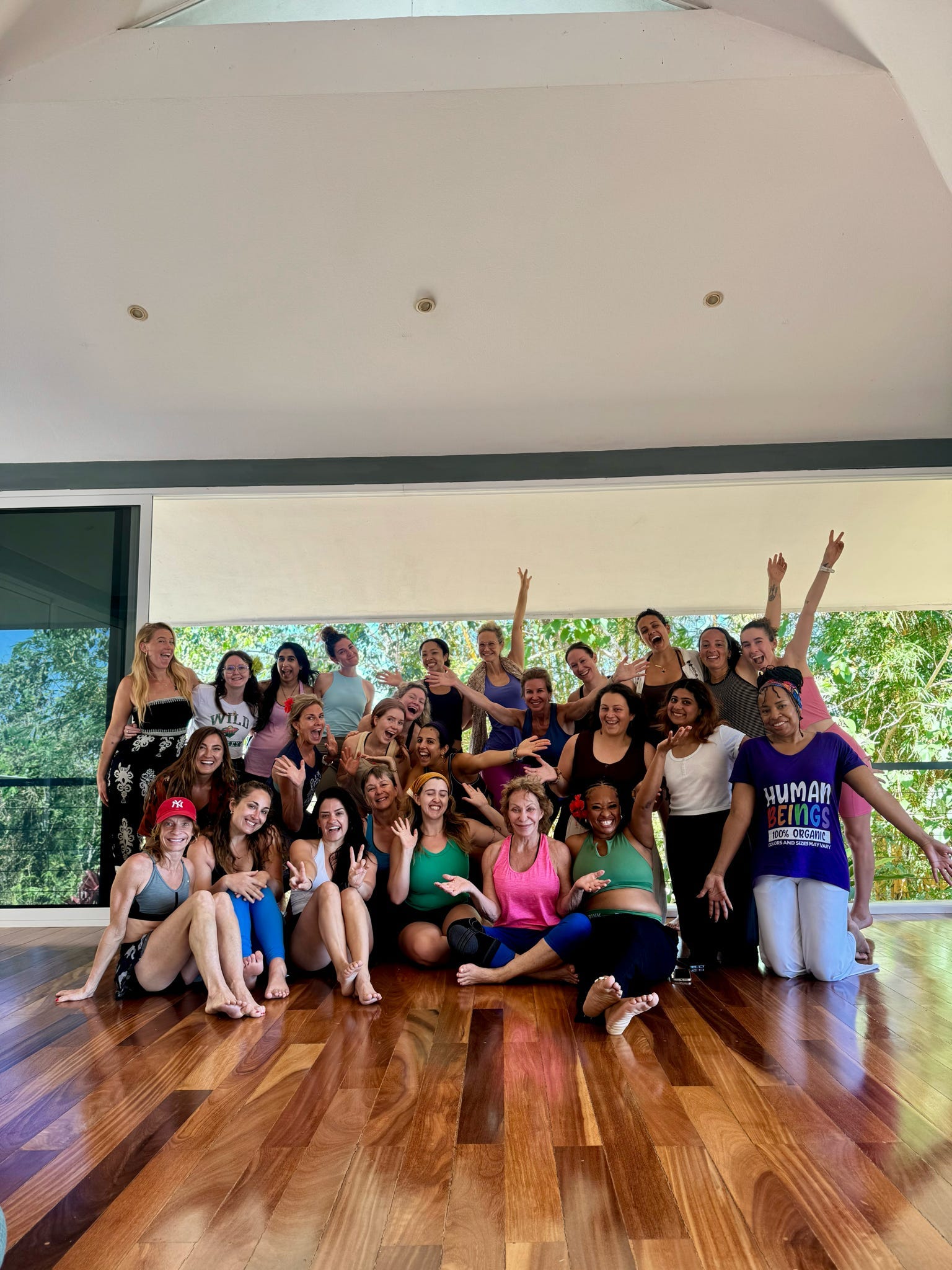
But it wasn’t just the training. It was the 25 incredibly compassionate, strong, and loving women I got to know along the way.
Before Costa Rica, we only knew each other as small squares on Zoom, sharing fragments of who we were. And yet, after just ten days together in the jungle, we left with something undeniable—a sense that these connections were not accidental. That we had all come together for a reason.
We would carry each other forward, holding tenderness not only for the stories we shared, but for the ways we were seen within them, and for the dreams still taking root.
The word yoga is derived from the Sanskrit root yuj, meaning to yoke or bring together. In its simplest form, yoga means to unite.
It’s not about how many chaturangas you can do, or whether you can master a headstand (I still can’t). It’s about guiding us toward deeper understanding—toward a greater capacity to be with ourselves, and with one another.
When I saw that the School of Yoga Institute and its sister school, Somatic Yoga Institute, were offering a 200-hour trauma-informed yoga teacher training, it felt like the curriculum I had been searching for.
Understanding poses, alignment, and anatomy matters. But what mattered most to me was learning how to create space where people feel safe enough to be themselves—and perhaps, to be witnessed in ways they haven’t been before.
When I signed up, it didn’t feel like a coincidence that the training fell so close to the one-year mark of my divorce. More than anything, it felt like an opportunity to return to myself.
At the time, the idea of teaching still felt far-fetched.
Imposter syndrome has a way of asking, How can I help others heal when I’m still healing?
My therapist gently challenges that by reminding me:
You don’t have to be fully healed to support others.
That reframe gives me permission to keep going—to tend to my own healing while also stepping toward the work I feel called to do. To trust that there is value not in having all the answers, but in being present enough to hold space for what’s real.
In our curriculum, trauma was described not simply as what happens to us, but what happens within us as a result of those experiences.
This furthered my belief in that our bodies absorb and reflect trauma we haven’t yet consciously processed. Trauma is a somatic reaction.
So much of what we carry lives beneath language. It shows up as tension, as patterns, as ways of bracing or disconnecting. And yet, many of us were never taught how to listen to those signals.
We ignore, rub dirt on our wounds, see our physical pain as its own entity separate from the emotional pain.
Until eventually, it catches up with us.
Our bodies begin to scream, begging us to pay attention.
Every single person in my training had walked through some form of pain. Different stories, different thresholds, different ways of coping. But one truth felt shared among us:
To be human is to experience pain.
Among my group were survivors of abuse, addiction, disease, body dysmorphia, systemic oppression, racism, and generational trauma. And still, there we were, sitting in a circle, finding a sense of safety and unity in a space that didn’t quiet our traumas, but allowed them to exist.
A space that reminded us our wounds can hold wisdom. That our pain can be part of our purpose.
“The cure for the pain is in the pain.” — Rumi
Our facilitators and teachers, Jeanine Talento and Brooke Alexander, nurtured an environment that felt both grounded and deeply intentional. They reminded us that this training wasn’t about actively processing our traumas, and emphasized the importance of having established support systems back home, like therapy.
That clarity allowed for sharing that was safely contained, while still leaving room for real emotional vulnerability.
I think it’s safe to say we all shed tears at some point during those ten days.
Throughout the experience, I found myself in both group discussions and quieter one-on-one conversations, often feeling deeply humbled by the stories being shared with me.
There were moments when people reflected back that they felt safe and grounded in my presence.
At first, those reflections were hard to take in.
These were people I admired—intelligent, open, and deeply self-aware, and yet they were gently holding up a mirror, showing me parts of myself I hadn’t fully seen. Naming my steadiness. My care. My presence.
The more I softened into receiving those words, the more I realized this wasn’t just happening to me.
It was happening between all of us.
A mutual witnessing.
We were seeing one another clearly, reflecting back strength, softness, resilience, truth. Not in a way that inflated us, but in a way that grounded us more deeply in who we already are.
We were connecting through our stories, through our different ways of expression, through the unique wisdom each of us carried.
And in acknowledging each other’s power gently and consistently, it became easier for each of us to step into our own as the days went on.
It reminded me how powerful it is to be seen—not for who we’re trying to be, but for who we already are.
I’ve always felt my power in expression.
Since I was a little girl, it’s shown up in different ways—music, dance, sports, poetry, painting, baking, photography, yoga. The list goes on.
When I think about the hardest seasons of my life, most recently my divorce, and wonder what helped me move through them, I always come back to one thing:
My ability to create.
And yet, working as a creative, it’s easy to compare yourself to people who have a clearly defined niche—one thing they’re known for. That comparison has often made me question my own path, making me feel like I’m not “focused enough.”
But the truth is, we’re not meant to be one-dimensional.
We are meant to create. Period.
Creativity is at the pulse of every major human movement. It’s acted as a response to pressure, rupture, identity and survival. Again and again history has repeated itself revealing that humans always return to art, to expression, to embodiment, to make sense of what we carry— to reimagine what is possible.
So how does this relate back to yoga?
It’s simple.
Yoga is art.
It’s the way every body moves differently through the same shape.
The way breath carries its own rhythm, its own story.
The way an exhale can hold grief one day, and relief the next.
A remembering that there is no “right” way to inhabit a body, only the way that is honest to you.
During the training, we had a discussion around the role of art in yoga. Our facilitators asked, “Who considers themselves an artist?”
Myself and about a third of the class raised their hands.
The conversation that followed—hearing why so many didn’t identify that way—ignited something in me.
A belief I had always felt, but hadn’t fully named:
“To be an artist is to express, not to produce.”
This was a moment where I felt that “clicking” everyone speaks about. And also a moment of realization that if that’s true, why have I spent so much of my life focused on producing?
Not anymore.
There’s something far more freeing about expressing without trying to impress. Because no matter what you create, it will resonate with some—and not with others. And that’s okay.
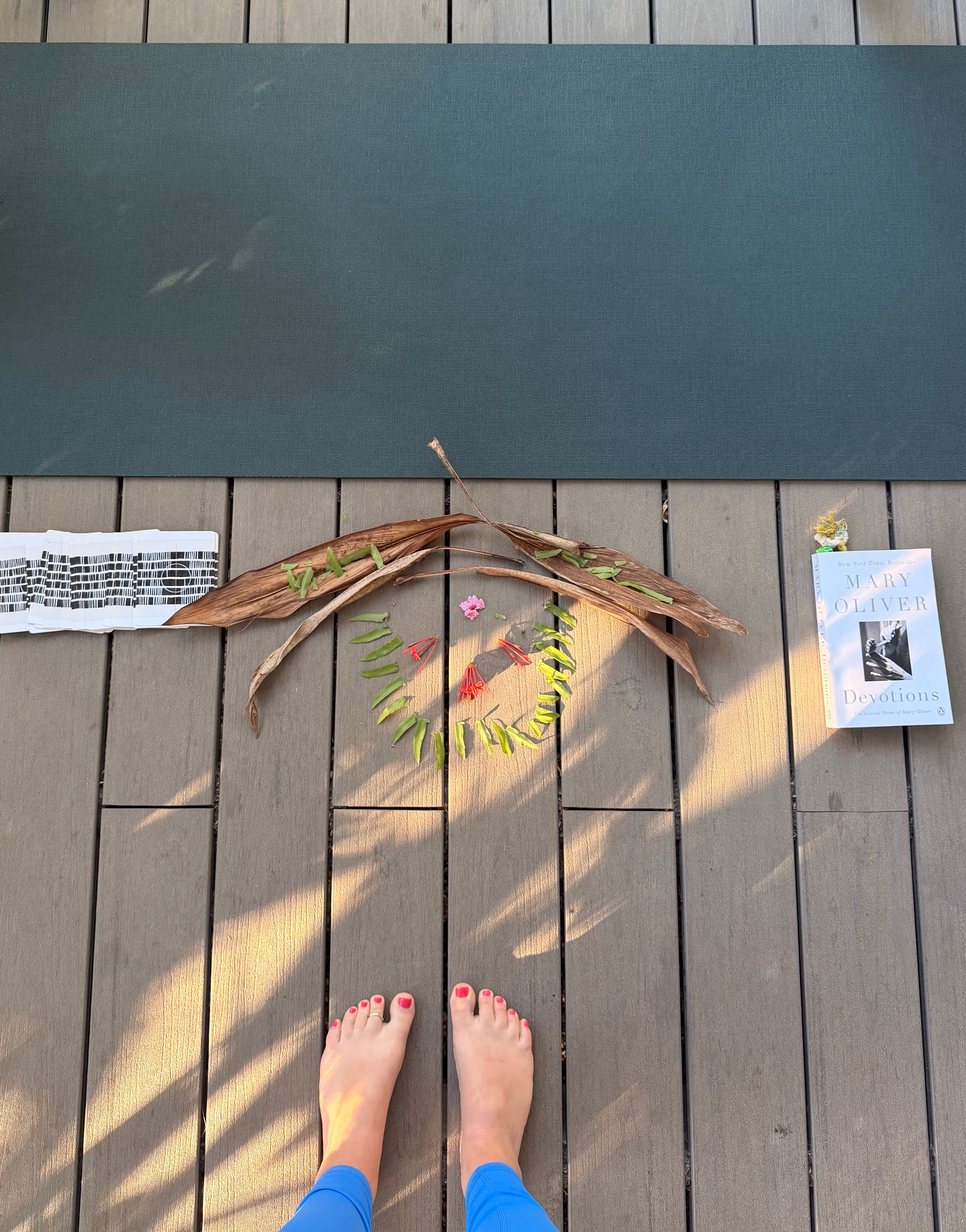
Later that week, we had an “Art Share” evening.
Each person had a minute to share something.
What followed was poetry, multicultural dance, paranormal storytelling, lessons on hair care, trauma-informed design, astrology. Even those who hadn’t raised their hands earlier shared.
A year ago, I picked up the guitar after thirteen years without a musical outlet. As I learned the basic chords, I began experimenting with my voice—for the first time, at 30 years old.
What came out of it was pure expression, unattached to outcome.
And it felt freeing.
When I learned one of our facilitators had brought her guitar to Costa Rica, I felt immediately overjoyed. Leaving mine behind had felt like a disruption in my safe routine from home.
Throughout the week, I found moments to sit in the yoga shala, playing alongside the sounds of the jungle. The acoustics in that space were magical.
At one point, I even texted my younger brother—who was watching my animals back home—asking him to send me a photo of lyrics I had written just months before.
So when the Art Share was announced, it felt like kismet.
I had played for friends one-on-one, but never for a group.
And yet, in that space, I felt safe enough to try.
Teaching my first yoga class. Sharing my music. Stepping more fully into who I am.
It felt like a reset my system had been asking for.
When I think about what’s next, I envision leading workshops that explore the synergy between movement and art. Spaces where people can reconnect with their bodies, their stories, and their ability to express what they carry.
For a long time, I didn’t feel ready.
But something shifted during these 10 days.
This training didn’t just teach me how to guide others through a practice.
It showed me that who I am, and what I offer, is enough.
That when you’re surrounded by the right people, they don’t tell you who to become.
They hold up a mirror and remind you of who you already are.
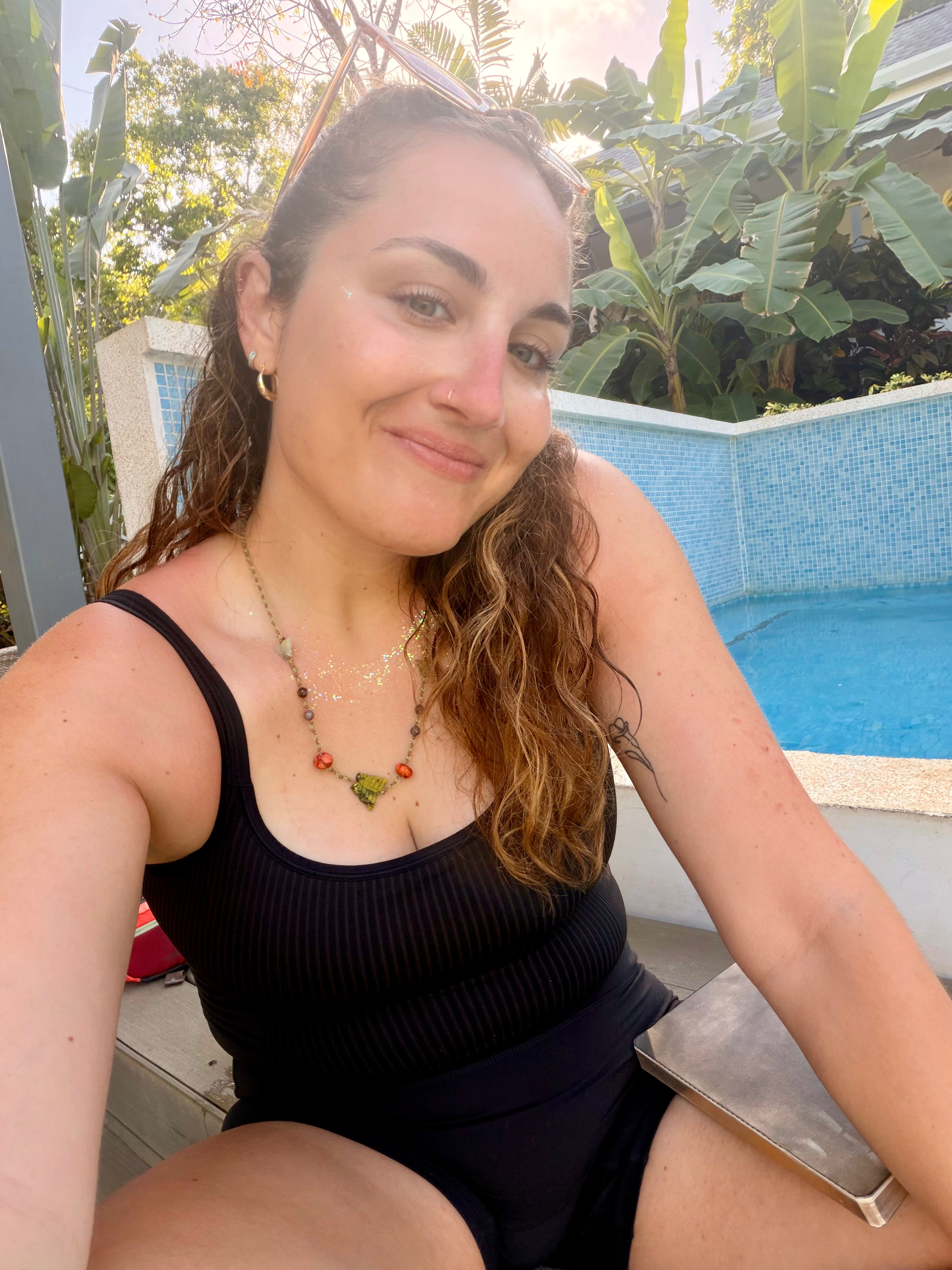
For the past year, so much of my life has been defined by what happened to me.
Now, I find myself asking a different question:
Who was I when this happened?
And who am I now—moving forward?
We all left Costa Rica with certificates in hand, returning to our different corners of the world.
Yes, we’ll bring yoga into our communities.
But more than that, we’ll carry the stories we hold—and the way we’ve learned to express them.
Because in the end, that’s what makes the difference.
I’m not here to perfect my expression.
I’m here to live inside of it.


Other little moments from Costa Rica that I don’t want to forget:
I arrived a day before training to get settled and stayed at a small boutique hotel called Sunshine Sanctuary. To kick off Day 1, I jumped off a cliff at Montezuma Waterfalls with one of my classmates, Beth. It felt like a beautiful, symbolic way to leap into a new chapter.
On the first full day of training, the majority of the class got scombroid poisoning, aka food poisoning from raw tuna after poke bowls at lunch. Classes were postponed while the resort brought in a doctor to give us all shots… in the ass. Not-so-glamorous, but honestly a hilarious way to bond right from the start.
Before leaving for Costa Rica, I decided I would wear body glitter every day—for no reason other than to share a little sparkle. On graduation day, I got to glitter the whole class.
We had a day off to go on excursions, and I chose snorkeling. Anyone who knows me knows I refuse to use the snorkel and instead free-dive so I can feel one with the fish. The coral reefs did not disappoint. The sunburn, unfortunately, did.
Aves, the resort where our training was held, made incredible, nourishing food the entire time—fresh fruit, juices, vegetables, and a few surprise sweet treats. My digestive system was very happy. :)
The wildlife! Beyond the fish, I made friends with a crew of coatimundis, and we spotted howler and spider monkeys throughout the week. I also had the unforgettable experience of encountering a Great Black Wasp… by getting stung in the thigh. The jungle really kept me on my toes.
Leading pinky prayers before meals—sharing gratitude for each other and the food, and ending together with a collective “Om.”
Our cacao ceremony, and an evening of simply being—listening to music, dancing, painting, and lying under the stars together.
I had the best roommates. Sharing space with Madison, Maryam, and June for ten days felt so easy—morning coffee rituals (thanks to June), reflecting on class, sitting out on the porch together, and laughing with Maryam right up until we fell asleep.
Getting paired with Rose for peer teaching was such a gift. We each taught a 90-minute class as part of our graduation requirements, and sharing that kind of intentional, intimate space with her is something I’ll never forget. A forever friend.
For graduation, one of my classmates, Corie—who also happens to be a professional hairstylist—braided my hair into a beautiful updo. Sitting there and receiving that small moment of care felt so special.
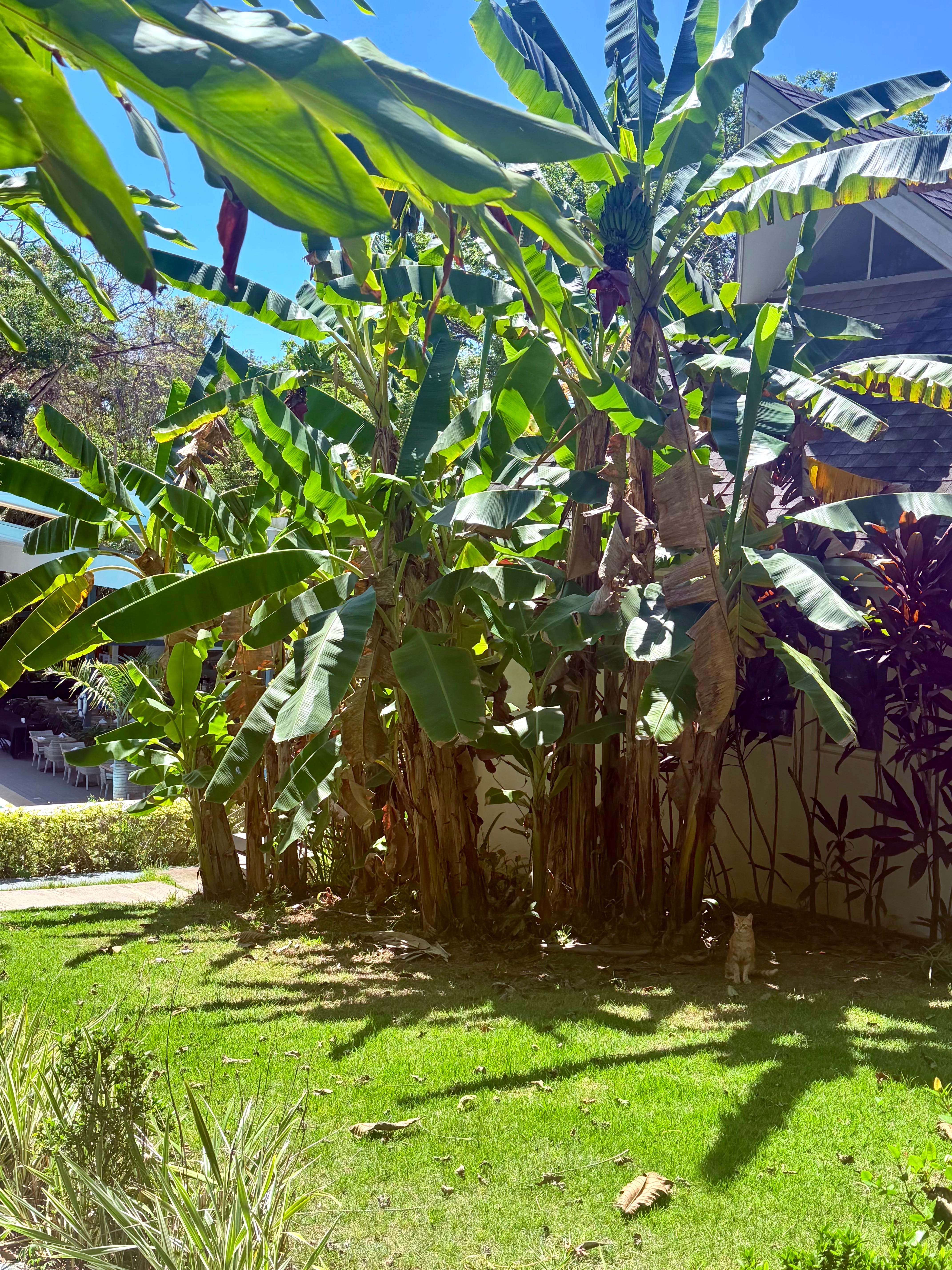
The dogs and cats that lived at Aves made everything feel more like home, often surprising us with visits during asana workshops.
Honestly, I could write a bullet for every single incredible human I shared this experience with—and why it feels like I walked away with an entire commune of sisters. I am blessed beyond measure.
Your persistence and resilience always astound me ❤️ I loved reading more about your trip!
Gorgeous. Your writing is so beautiful and clear, and weaves together so many deep truths. It is a blessing to experience this writing, you, and your art. <3